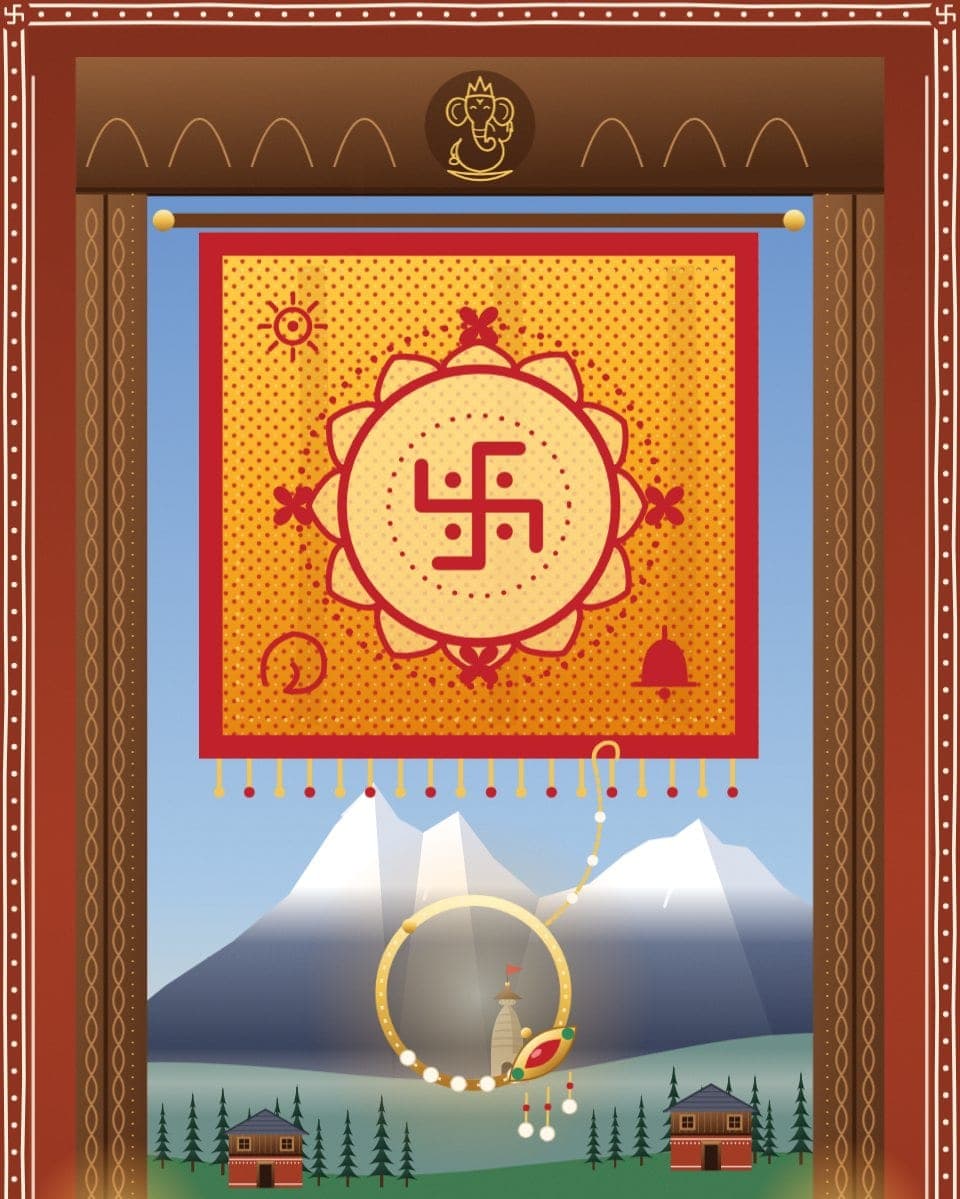
A Kumaoni wedding invitation is a wedding card in the style of Kumaon, the eastern hill region of Uttarakhand around Almora, Nainital, Pithoragarh and Bageshwar. It opens with Ganesh, lists the family's functions in the order they happen, and is decorated with aipan, the red-and-white ritual art that Kumaoni women paint on floors, walls and doorsteps for every auspicious day.
This guide has four parts: what goes on the card, function by function, the aipan motifs and what they mean, wording in Hindi, Kumaoni and English you can copy, and an animated pahadi byah invitation that tells the whole wedding as a short film and is sent as one WhatsApp link.
What a Kumaoni wedding invitation says
Strip a Kumaoni wedding card down and it always says the same five things, in this order:
- The invocation. Ganesh first: ॥ श्री गणेशाय नमः ॥, or the full वक्रतुण्ड महाकाय shlok.
- Who is inviting, and to whose wedding. Both sets of parents as hosts, the bride's and the groom's names, and often a line asking for the blessings of the family deity: Golu Devta, Maa Nanda Devi, or your own kul devta.
- Every function. Date, time and venue for each one your family is holding. In the hills the functions are often at two homes in two villages, so the venue line matters more than usual.
- A welcome. A closing line that asks guests to come, ideally in the family's own words.
- The families. The family names sign the card last.
What makes it Kumaoni rather than generically Indian is the decoration and the details: aipan in geru and white instead of marigold clip art, the dhuli arghya time printed with the baraat, and the rituals named the way the family names them.
The Kumaoni wedding, function by function
Customs differ from family to family and valley to valley, so treat this as the common shape, and put on your card only the functions your family is holding.
| Function | What happens | What to print |
|---|---|---|
| Ganesh puja (गणेश पूजा) | Preparations begin with Ganesh puja. Small cloth bundles of haldi, roli, supari, akshat and a coin are tied and placed in the kitchen, at the entrance and on the kadhai the wedding food will be cooked in. | Usually not printed; it is family-only. |
| Suwal pathai (सुवाल पथाई) | One, three or five days before the wedding, at both homes, the women roll thin wheat suwal, sun-dry and fry them. They are offered to the gods and shared with guests. | Date and home, if you are inviting the women of the extended family. |
| Haldi (हल्दी) | Turmeric for the bride and the groom at their own homes. | Date, time, venue. |
| Sangeet and mehendi (संगीत · मेहंदी) | An evening of songs and henna that many Pahadi families now add, especially when relatives travel up from the plains. | Date, time, venue. |
| Baraat and dhuli arghya (बारात · धूलि अर्घ) | The baraat arrives at godhuli, the dusk hour, led by chholiya sword dancers with the dhol-damau. At the door the bride's father worships the groom as Vishnu and washes his feet. | The baraat's arrival or the dhuli arghya time. |
| Kanyadaan and the pheras (कन्यादान · फेरे) | The bride's parents give her hand, and the couple walk round the sacred fire tied in the gathbandhan. | Wedding date, lagna or time, venue. |
| Vidai (विदाई) | The bride leaves for her new home with the pichhora over her head. | Not printed. |
Before you send
- Two homes, two venues. If the haldi is at the bride's village and the wedding is at a hall in Haldwani, print both venues in full. Relatives from the plains will open the card on the road.
- Name the lagna. If the wedding is fixed by muhurat, print lagna and the time (for example godhuli lagna, 6:15 PM), not just "evening".
- Say who the haldi is for. "Haldi at the bride's home" saves a dozen phone calls.
Aipan on a wedding card: the motifs and what they mean
Aipan is painted with the fingers. A floor or wall is first coated with geru, a red ochre clay from the Kumaon hills, and the design is painted over it in biswar, a paste of rice soaked overnight and ground fine. The knowledge passes from mother to daughter, and in 2021 Kumaon's aipan received a Geographical Indication (GI) tag.
On a wedding card, each motif means something:
| Motif | Devanagari | What it means |
|---|---|---|
| Lakshmi's footprints | लक्ष्मी के पैर | Drawn walking into the home, never out, so prosperity enters. |
| The chowki | चौकी | A square aipan drawn as the seat of a ritual, where the kalash or the deity is placed. |
| Swastik and four dots | स्वस्तिक | The mark of an auspicious beginning, on the kalash, the threshold and the card. |
| The lotus | कमल | Purity, and the seat of Lakshmi. |
| Vasudhara | वसुधारा | White lines running down from a threshold or a sacred wall. |
| Geru and biswar | गेरू · बिस्वार | The ground and the line: red earth and white rice, the colours of every aipan. |
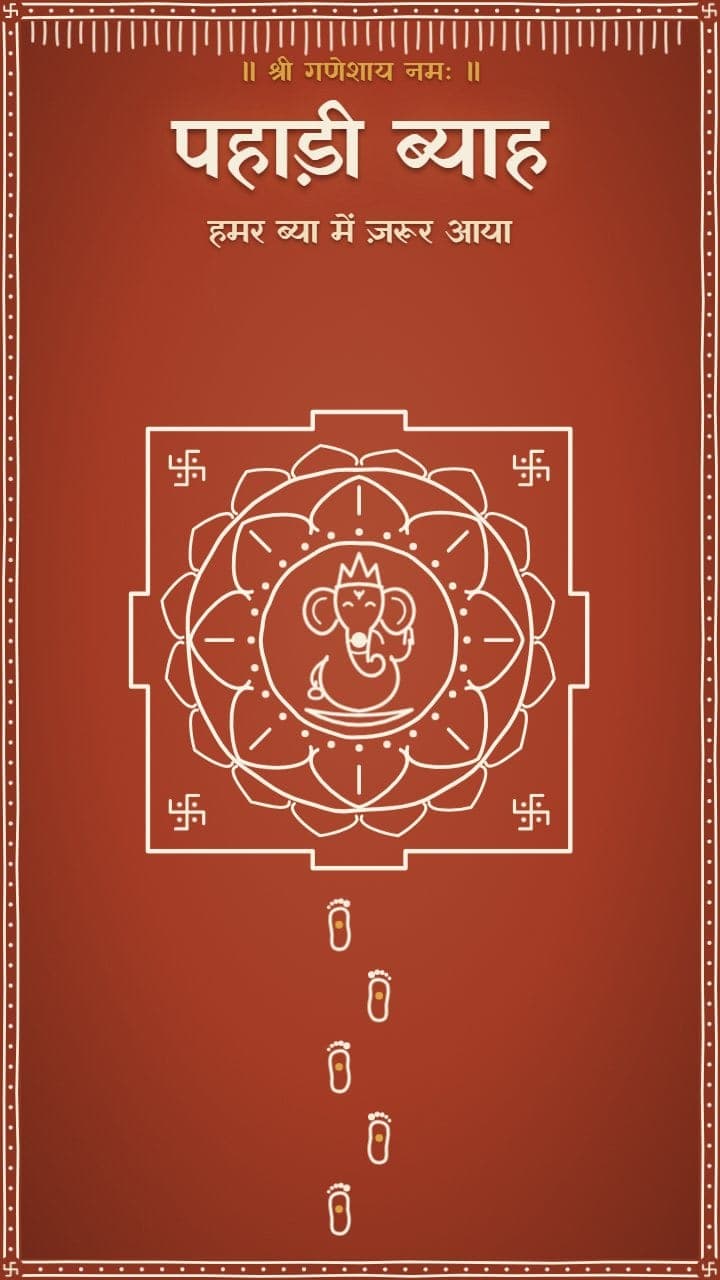
A card that uses these in the right places reads as Kumaoni at a glance: Lakshmi's footprints walking towards Ganesh, a chowki holding the haldi details, a lotus round the fire.

The pichhora and the nath
Two things make a Kumaoni bride recognisable anywhere: the rangwali pichhora and the nath.
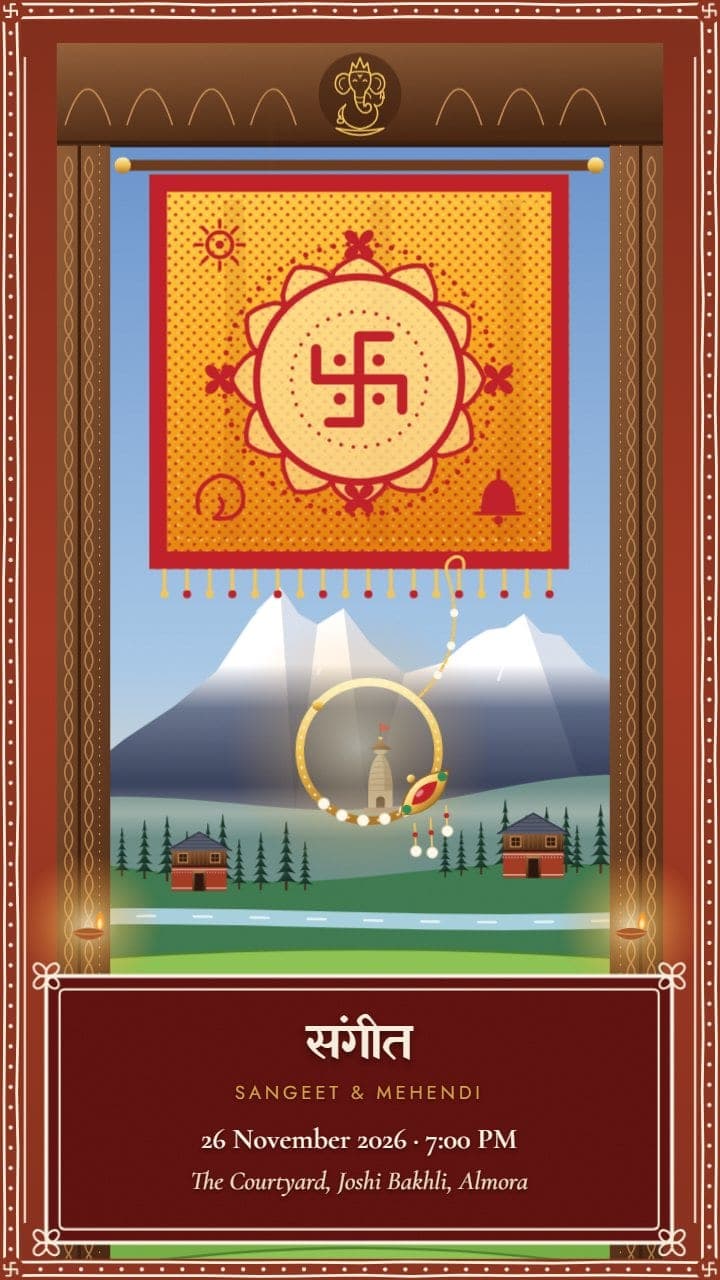
The pichhora is a stole dyed saffron, worked with red dots and designs, and at its heart an aipan-like medallion, often a swastik with the sun, the moon, a conch and a bell around it. Kumaoni brides wear it, and married women wear it at every auspicious ceremony after that. The nath is the large gold nose ring of a Pahadi bride, set with stones and pearls, its chain caught up into the hair.
Both belong on the card. A pichhora border or medallion, or the nath as a motif, tells every relative before they read a word that this is a pahadi byah.
Kumaoni wedding invitation wording
Keep the invocation and title in Devanagari, the details in the language your guests read (Hindi or English, or both), and the welcome in Kumaoni, written the way your own family says it. Tap any line to copy it.
Invocations
॥ श्री गणेशाय नमः ॥
वक्रतुण्ड महाकाय सूर्यकोटि समप्रभ। निर्विघ्नं कुरु मे देव सर्वकार्येषु सर्वदा॥
Titles
पहाड़ी ब्याह
शुभ विवाह
Deepa weds Himanshu
The invitation line
With the blessings of Golu Devta and our elders, we invite you to the wedding of our children
With the blessings of Maa Nanda Devi, the Joshi and Bisht families invite you home to the hills
श्री गोलू देवता के आशीर्वाद से हमारे परिवार में मंगल अवसर पर आप सादर आमंत्रित हैं
Hosts
Smt. & Shri Mohan Chandra Joshi, Lala Bazaar, Almora
Smt. & Shri Harish Singh Bisht, Bageshwar
Welcome and closing
Ask an elder to read the Kumaoni line before you send it; the same sentence is said differently in Almora, Pithoragarh and Champawat.
हमर ब्या में ज़रूर आया
आपकी उपस्थिति हमारे लिए आशीर्वाद है
Your presence is the blessing we seek. Come, be a part of our pahadi byah.
The aipan is drying and the suwal are fried. All we need now is you.
The WhatsApp message that goes with the link
Our pahadi byah invitation 🏔️ Sound on, it starts with the aipan.
Shaadi ka card bheja hai 🙏 ek baar poora dekhna, pura Kumaon dikhega.
The card for our wedding 🙏 Haldi on the 26th at home, the baraat on the 27th. Please come.
For wording for every other function, from engagement to griha pravesh, see 100+ invitation messages and wording samples.
A Kumaoni wedding invitation that plays like a film
The Pahadi Byah Kumaoni wedding invitation on MomentoCard tells the whole wedding as a 59-second story, and every scene carries one part of the card:
- Ganesh, painted in aipan. A geru floor, a single dot of rice paste, then a finger paints the yantra, Ganesh at its heart and Lakshmi's footprints walking in. Your invocation, the title पहाड़ी ब्याह and your Kumaoni welcome.
- The valley at morning. Snow peaks above a green Kumaon valley: terraced fields, deodar forest, buransh in bloom, a stone temple on the ridge, the river and slate-roofed houses. Your invitation line and both sets of parents.
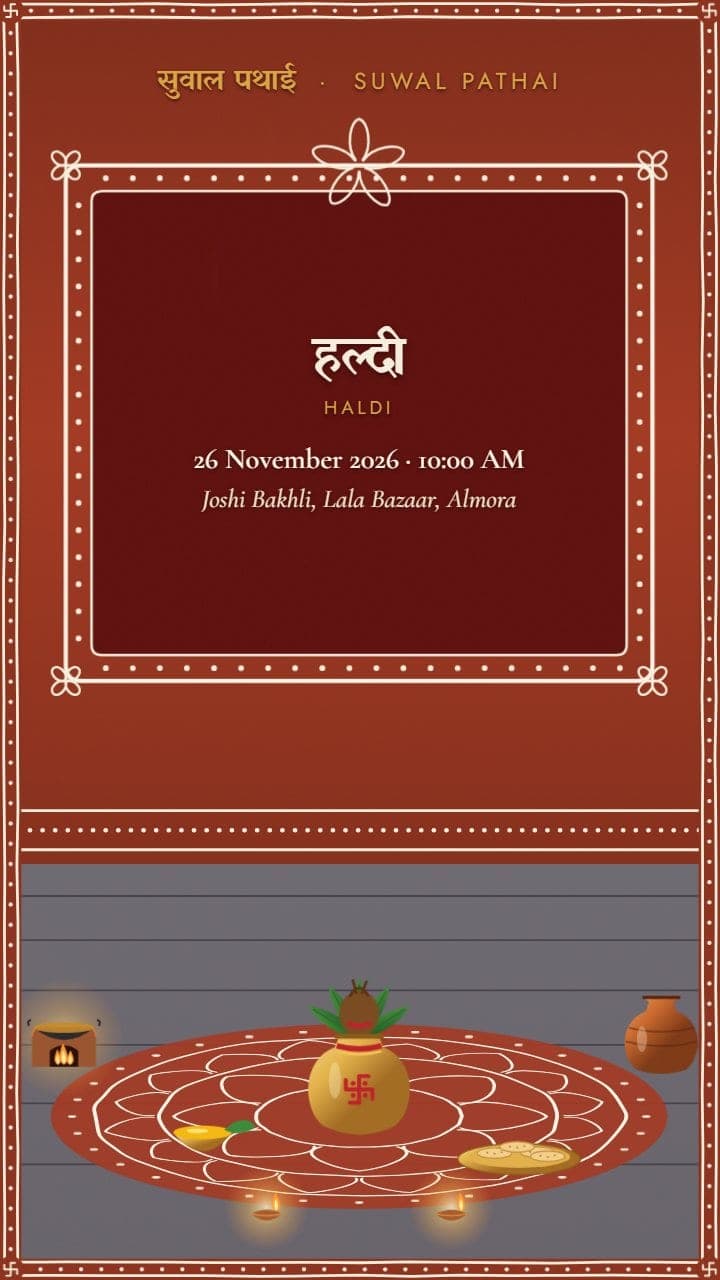
- Suwal pathai and the haldi. A brass kalash, haldi, a parat filling with suwal, a copper gagri and diyas on an aipan chowki. The haldi details are painted on the wall as a chowki of their own.
- The pichhora and the nath. In a carved likhai doorway with Ganesh on the lintel, the rangwali pichhora unrolls and the great gold nath appears. Sangeet and mehendi.
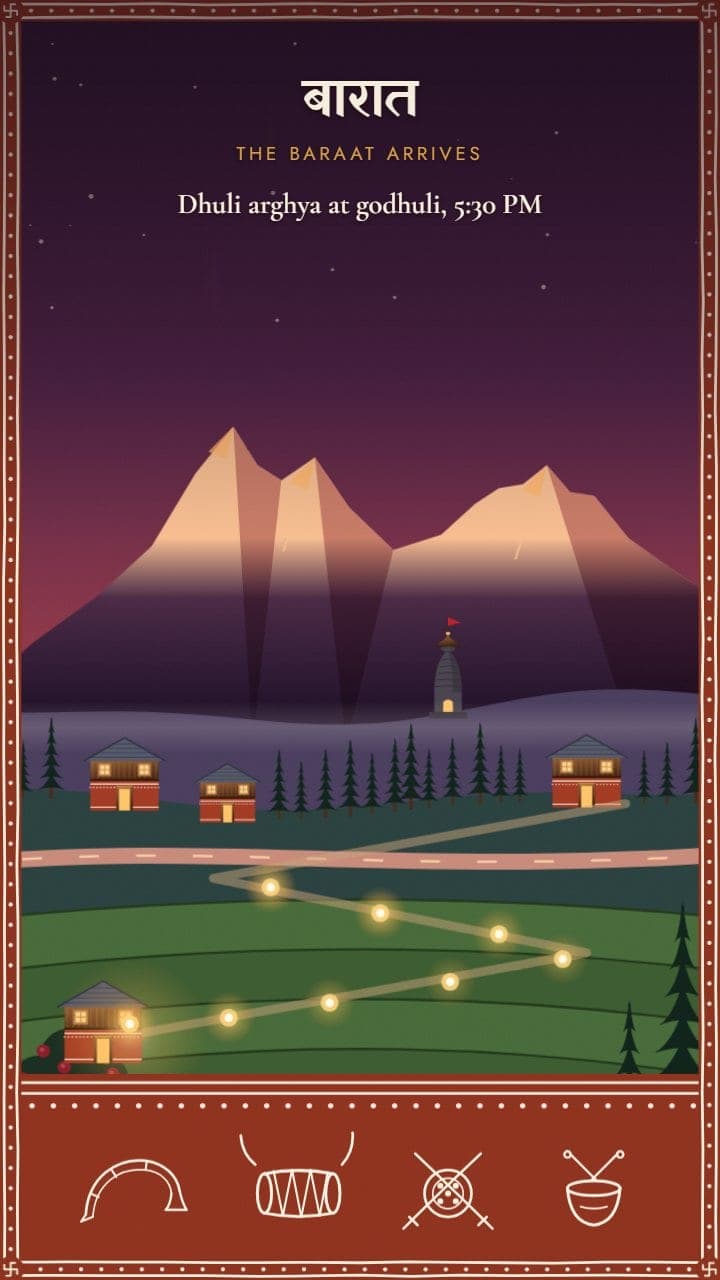
- The baraat at dusk. Lanterns wind down the hill to the bride's lit door, over an aipan frieze of dhol, damau, ransingha and the chholiya dancers' swords and shield. The dhuli arghya time.
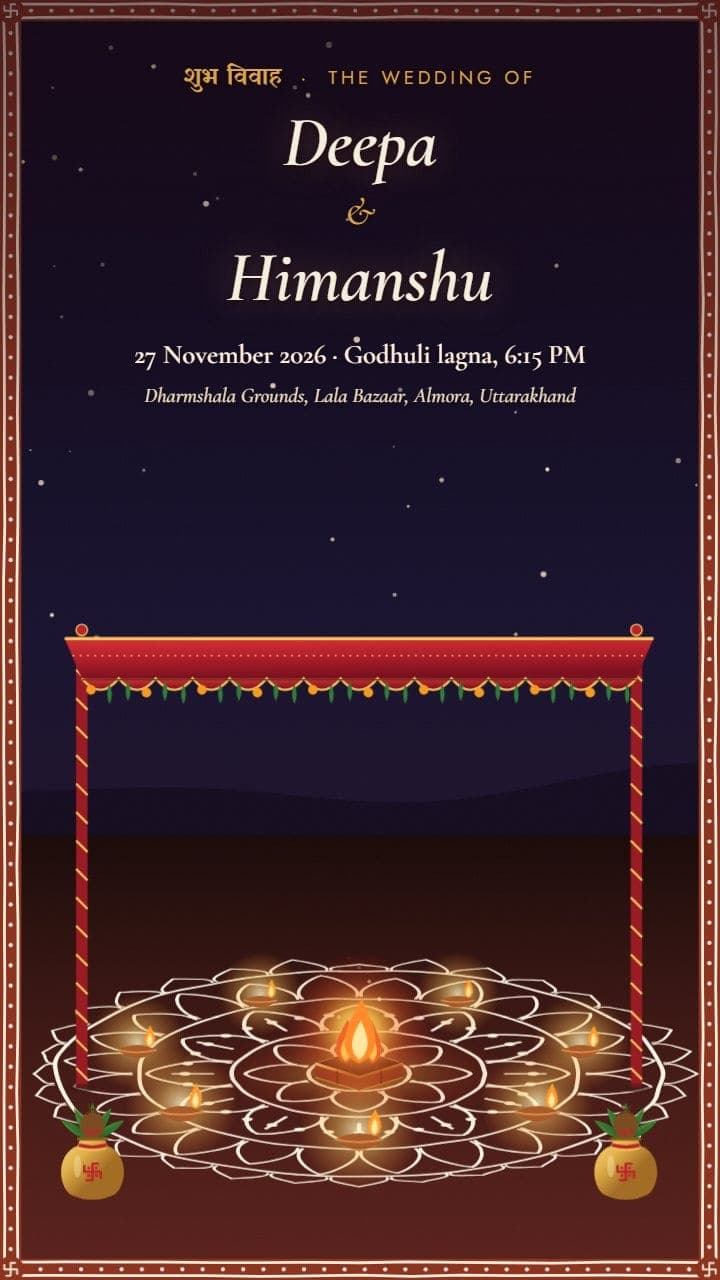
- Seven diyas for the pheras. Under a red mandap, a great aipan lotus is painted round the fire and a light circles it, lighting seven diyas. Your names are painted in by hand, with the date, lagna and venue.
- Dawn and the temple bells. The snow turns pink above the valley, brass bells swing along the top of the wall, and your families sign the card last.
It plays by itself, and four optional taps (paint the aipan, unroll the pichhora, light the baraat's way, begin the pheras) let a guest move it along. Every word is editable, every field takes Devanagari, two photos are optional, and it comes in 9:16 for WhatsApp status and 16:9 for a television at the haldi. You can watch it with your own names before you make one.
Make the Pahadi Byah invitation
If you would rather have a pan-Indian card with a maps button and a one-tap WhatsApp RSVP, use the Royal Shaadi Invite; for a quick status post alongside either, the Pahadi Shaadi Story is a still 9:16 story with mountains and a dhol beat.
Printed card or WhatsApp link?
Both, for different people.
- Print a few for the grandparents, the elders who keep every card, and the family deity. A printed card with an aipan border is still the respectful way to invite the eldest generation in person.
- Send the link to everyone else. Relatives in Delhi, Dehradun, Haldwani and abroad, college friends, colleagues. It opens in any phone browser, needs no app, and the same link shows the new details if a muhurat or venue changes.
- Do not send a PDF of the printed card. It is unreadable on a phone, nobody can tap an address, and it cannot be updated.
For the full comparison, read digital cards vs paper cards and Indian wedding invitations online.
When to send it
- Elders first, in person. Invite the grandparents and the eldest relatives the traditional way before the link goes out.
- The link three to four weeks before. Late enough that the dates are fixed, early enough for relatives who have to book a bus or a cab up the hill.
- A reminder two days before the haldi. Send the same link again with one line about the first function.
- The video on your status the week of the wedding. The 9:16 version is made for it.
Before you send
Before you send it, check three things: every venue has the village or locality as well as the house or hall name, the lagna time is the one the pandit gave you, and an elder has read the Kumaoni line.