成人の日 · Monday, 11 January 2027
A Coming of Age Day card they will open twice
成人おめでとう
The red sun and the plum blossom, the shrine in the snow, a furisode or a montsuki hakama on its stand, the daruma and the first toast, and dawn with a thousand cranes. A 50-second animated Seijin no Hi card with their name, your words and a photo, sent as one link.
- 50-second story, five scenes
- Furisode or montsuki hakama
- One link on LINE or WhatsApp
At a glance
What a Coming of Age Day card is, and what this one does
Seijin no Hi (成人の日) is Japan's Coming of Age Day, on the second Monday of January, when everyone turning twenty is welcomed into adulthood at a city ceremony called the seijin-shiki. Families send congratulations, the new adults dress in furisode or hakama, and the day ends with photos, a shrine visit and the first legal drink. Hatachi is a 50-second animated card for exactly that: the sun and the plum blossom, the shrine in the snow, the outfit on its stand, the daruma and the toast, and dawn with a thousand cranes, carrying their name, your message, a photo and the ceremony details. You build it in the browser in about three minutes and send it as one link, or export it as a video for Instagram or LINE.
Length
50 seconds, five scenes
Taps
Three, all optional
Outfit
Furisode or montsuki hakama
Words
Japanese, English or both
Photo
One, in a mizuhiki frame
Formats
9:16 stories and 16:9 video
Music
A koto score, or your own track
Price
Free to build and preview
Try it with their name
名前を入れてみる
Watch the card play, right here
Type the new adult's name and who the card is from, pick the outfit, and the real card plays in the phone with your words in it. Tap the sun, the obi and the daruma as they light up.
- 50 seconds, five scenes, plays by itself.
- Three optional taps: open the blossoms, tie the obi, paint the daruma's eye.
- A koto score, or any song from the library.
Scene by scene
物語
Five scenes, one morning in January
Every scene is drawn in SVG and painted in as it plays, so it loads instantly on any phone, and every scene holds one part of what you want to say.
Scene 1
日の丸と梅
The sun and the ume
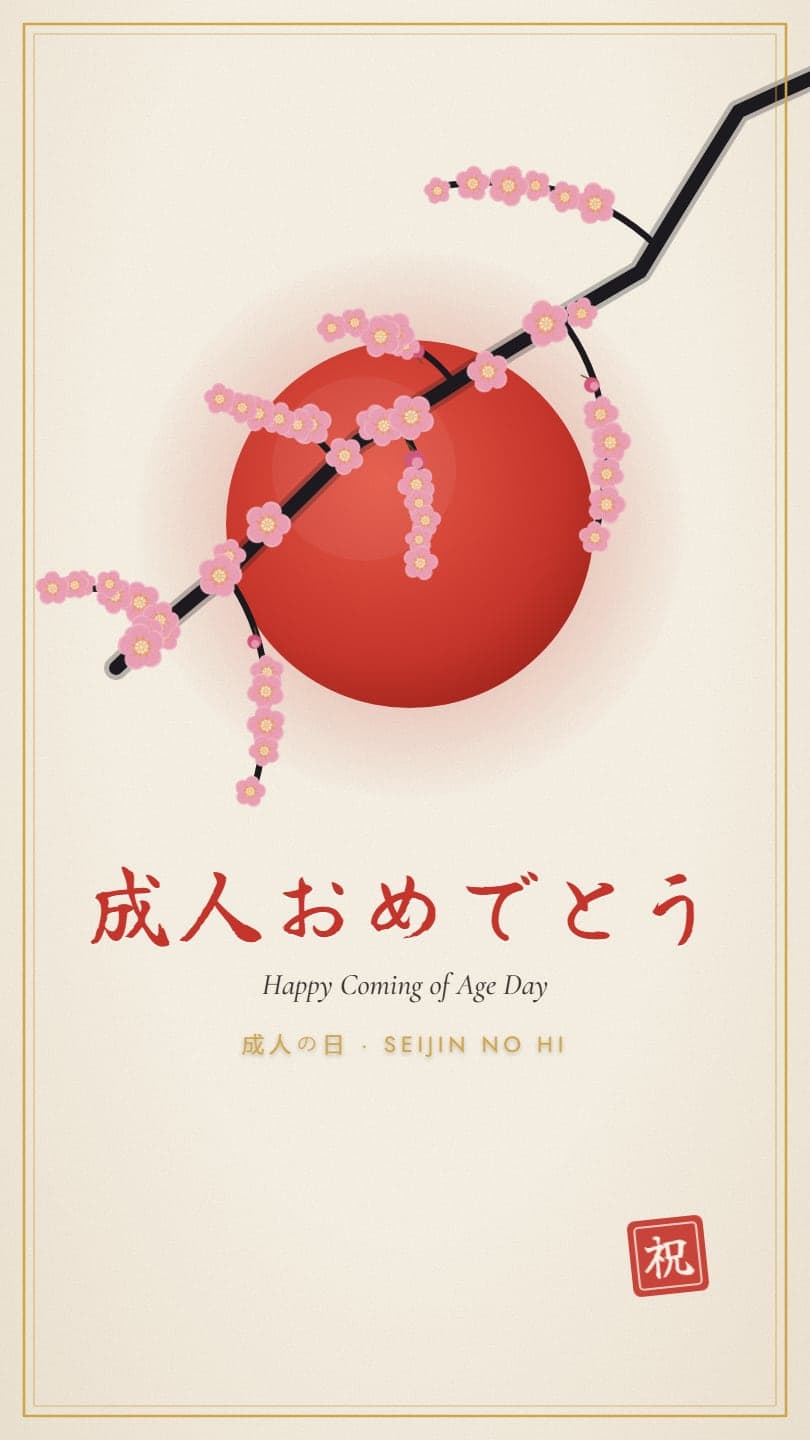
A sheet of washi, a thin gold frame. The red sun rises. A plum bough is drawn across it in one stroke of sumi, twig by twig, and then every bud opens at once. 成人おめでとう is brushed in underneath, with the date.
The custom
Ume, the plum, is the flower of January: it blooms in the cold before anything else, which is why it stands for perseverance and a fresh start. The red sun is the hinomaru. Together they are the look of a Japanese New Year card, which is exactly the season the ceremony falls in.
Your words here
Your title (成人おめでとう, or anything), a subtitle, and the Seijin no Hi date.
Optional tap: Open the blossoms
Scene 2
神社の朝
Morning at the shrine
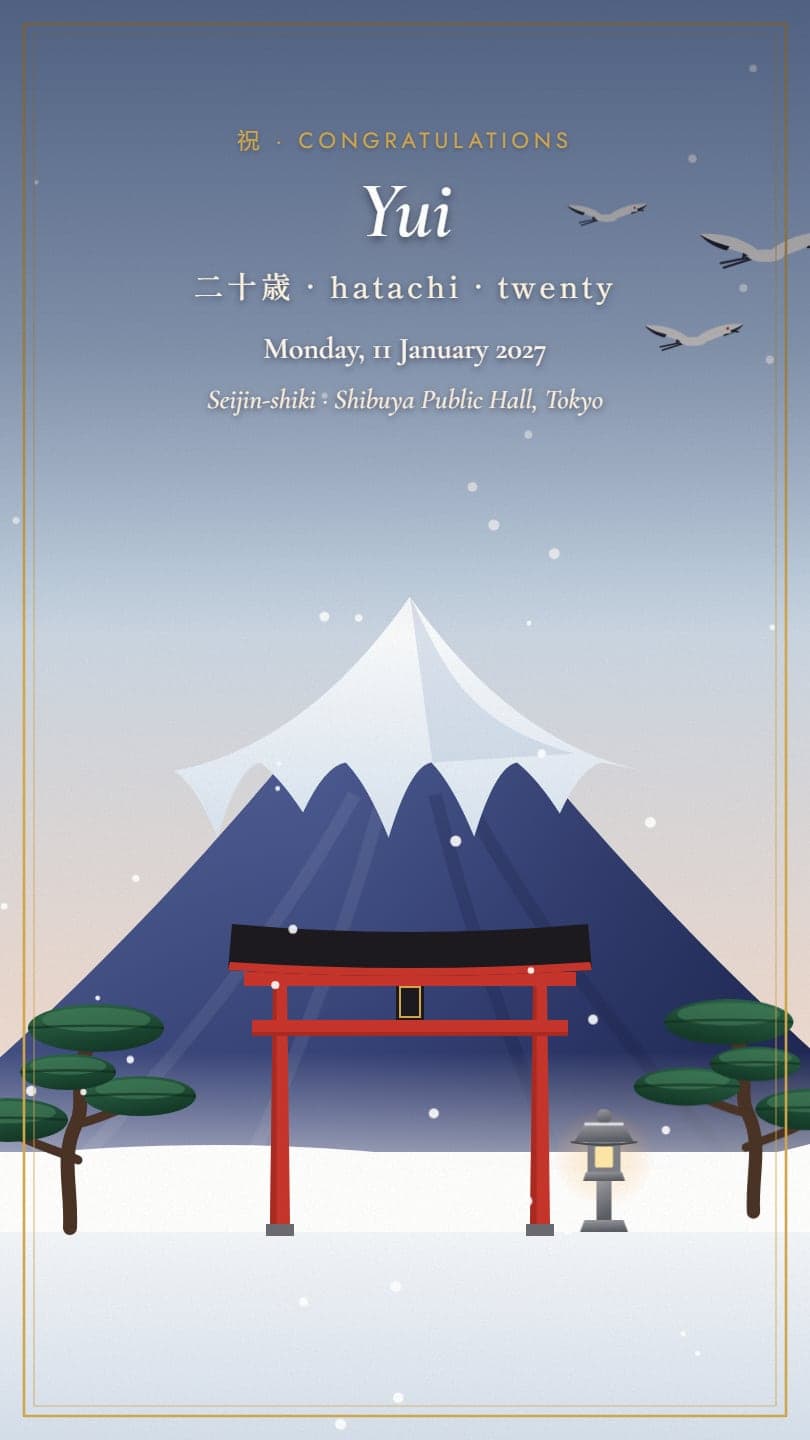
Fuji under snow, a vermilion torii, two pines and a stone lantern. Cranes cross the sky while snow falls. The new adult's name is written across the morning with 二十歳 and the ceremony's date and hall.
The custom
Many families visit a shrine on the day, before or after the city's seijin-shiki, to give thanks and pray for the road ahead. The crane (tsuru) is the bird of long life and good fortune, and the pine stays green through winter: both are classic wishes for a new adult.
Your words here
Their name, the age line (二十歳 · hatachi), and the ceremony date and hall.
Scene 3
振袖 · 紋付袴
The furisode on its stand
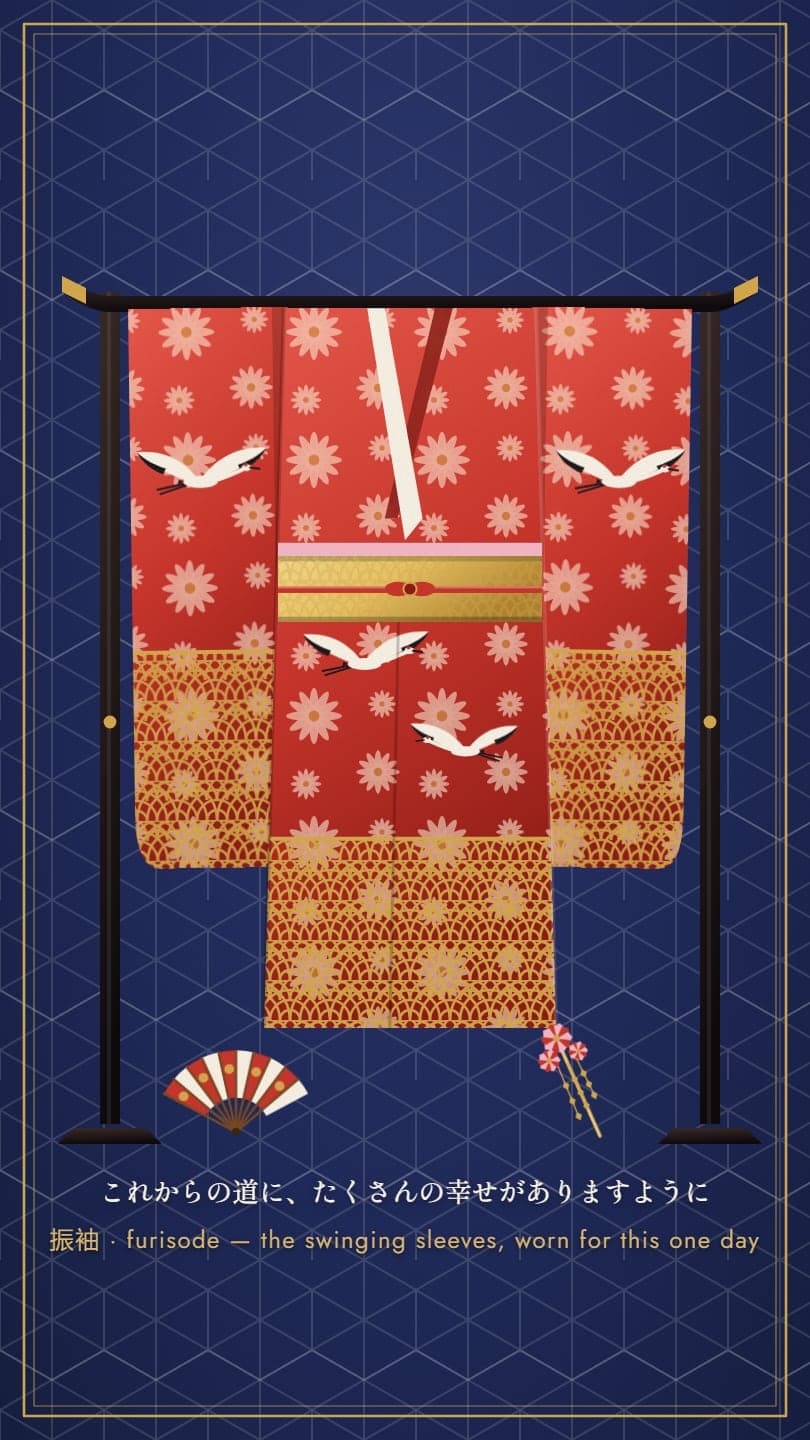
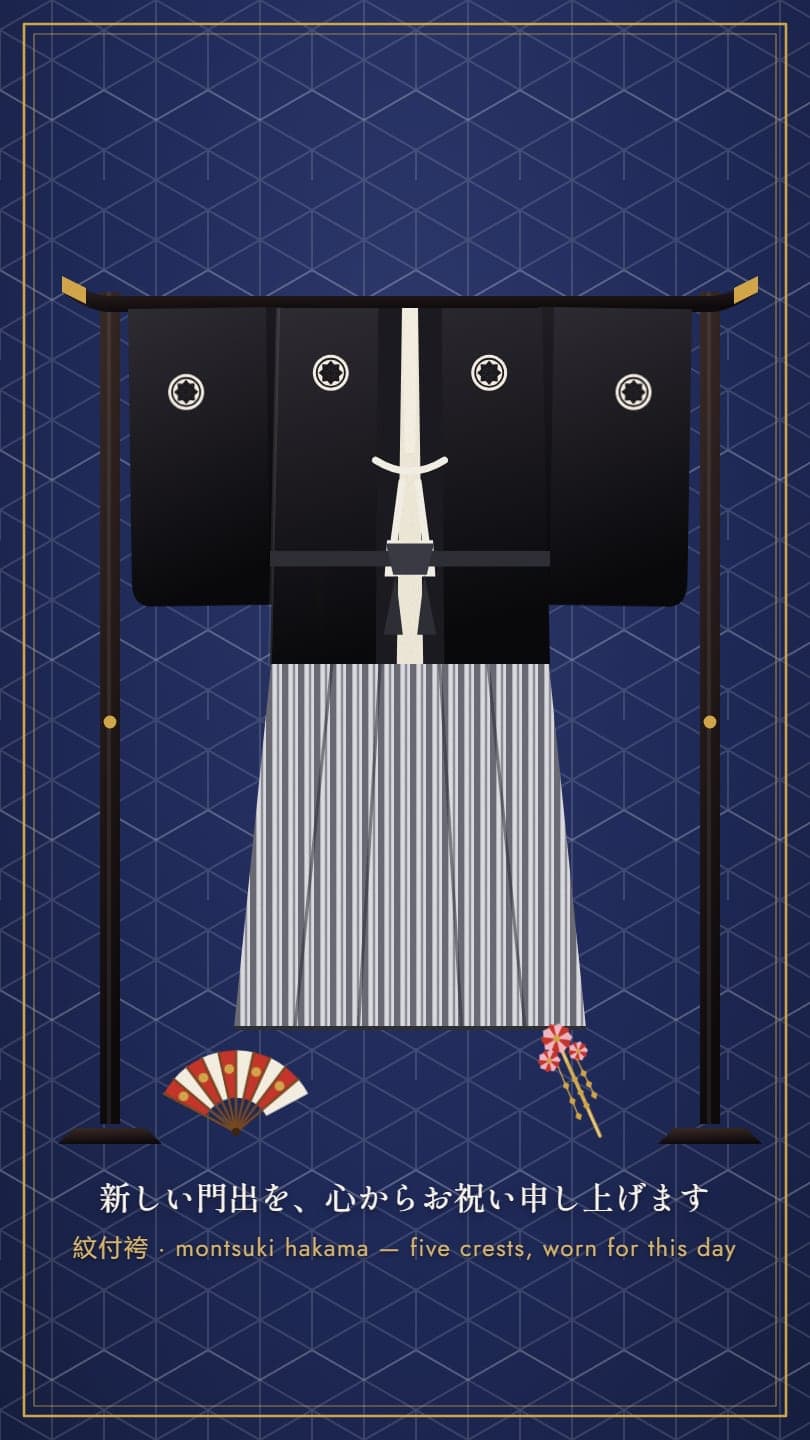
On an indigo wall of asanoha, a kimono stand. A vermilion furisode unrolls from the rail, cranes and chrysanthemums over seigaiha waves at the hem; the gold obi ties itself with a tap; a folding fan opens and a kanzashi is laid out. Or choose the montsuki hakama: black haori with five white crests over striped hakama.
The custom
A furisode is the long-sleeved kimono an unmarried young woman wears, and Seijin no Hi is its great occasion; many are rented or passed down. Young men wear a suit or the formal montsuki haori and hakama. The asanoha (hemp-leaf) pattern is an old wish for a child to grow straight and strong.
Your words here
Your greeting line, in Japanese or any language, and the outfit you pick.
Optional tap: Tie the obi
Scene 4
乾杯
The first toast
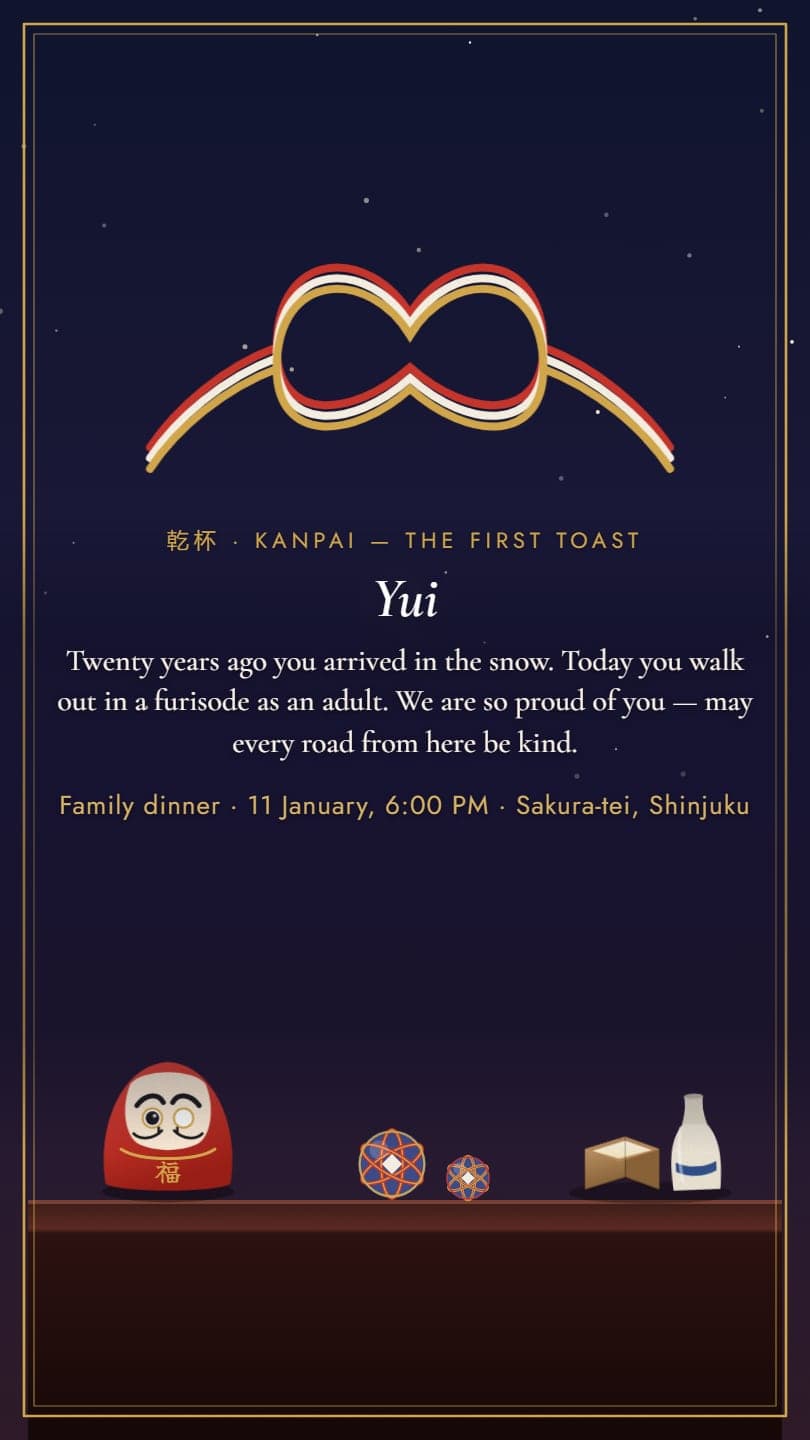
A lacquer table under the stars: a daruma waiting for its eye, two temari balls, a masu of sake and a tokkuri. A tap paints the daruma's first eye; the tokkuri tips and pours. Their photo sits above in a mizuhiki frame, over your message.
The custom
Painting a daruma's first eye is how you set out on a goal, the second when it is reached, so it is a fitting gift for a new adult. Twenty is the legal drinking age in Japan, which makes the first sake at the family dinner a small ceremony of its own. The mizuhiki knot ties every celebration gift.
Your words here
Their photo (optional), your message, and the celebration details.
Optional tap: Paint the daruma's eye
Scene 5
初日の出
Dawn, and a thousand cranes
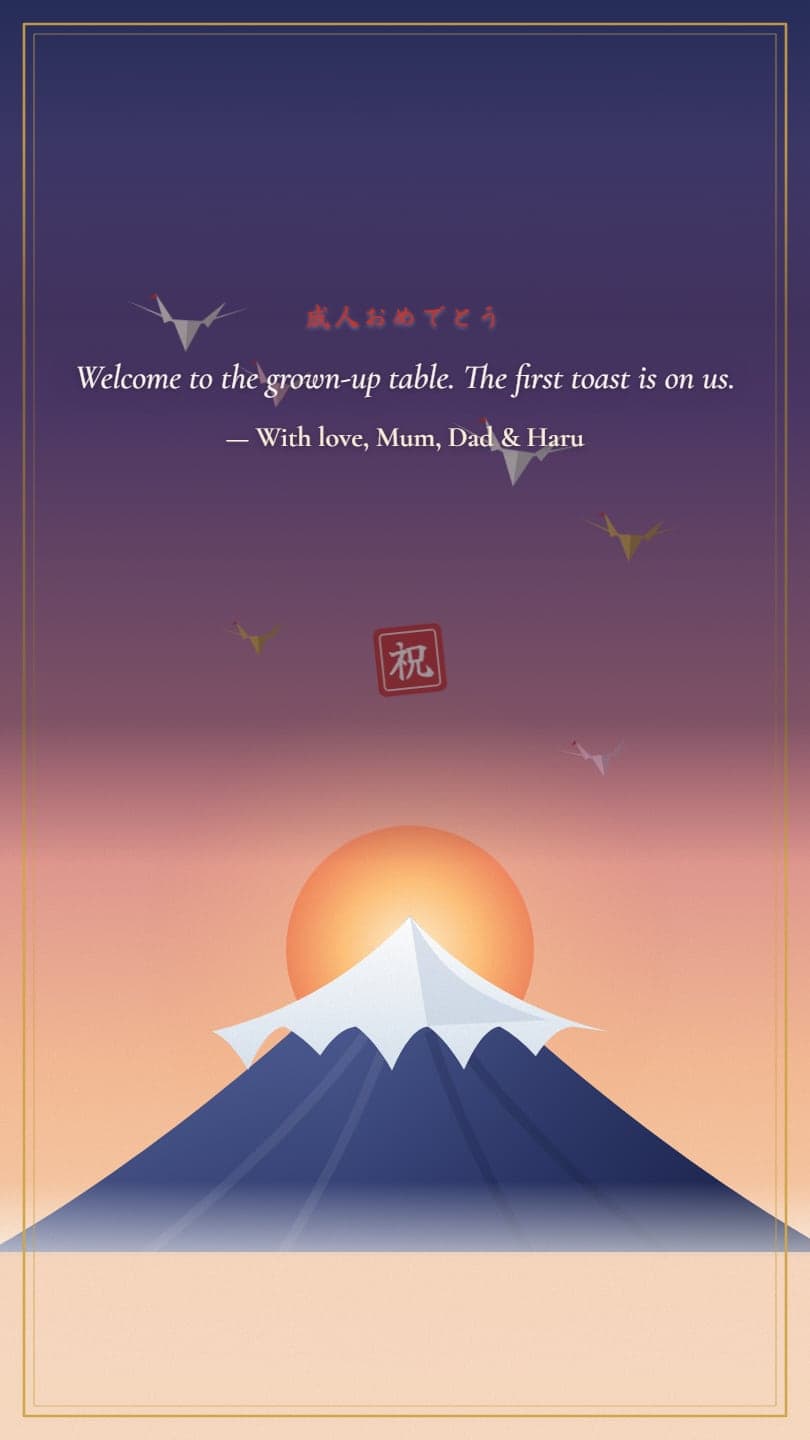
The sky turns to dawn over Fuji and the sun climbs behind the summit. Paper cranes rise past the mountain while your closing words appear, the senders sign, and the red seal lands.
The custom
Folding cranes is how Japan wishes someone well through something hard or new; a thousand of them is the biggest wish there is. The seal is a hanko, the stamp that stands for your name on everything official: a new adult's first real one is a common coming-of-age gift.
Your words here
Your closing words and who the card is from.
Pick the outfit
振袖か、紋付袴か
Furisode or montsuki hakama
振袖
Furisode
The long-sleeved kimono young women wear for the ceremony, in vermilion silk with cranes, chrysanthemums and a seigaiha hem. The gold obi ties with a tap; a fan opens and a kanzashi is laid out beside it.
紋付袴
Montsuki hakama
The men's formal dress: a black haori with five white crests over pleated sendaihira-striped hakama, with the white haori cord. The cord ties with the same tap. Pick it from a dropdown in the editor.
The things in the card
用語
A small glossary of the day
- 成人の日Seijin no Hi
- Coming of Age Day, a national holiday on the second Monday of January that welcomes everyone who turns twenty this school year into adulthood.
- 成人式Seijin-shiki
- The ceremony itself, held by each city or ward, usually in a hall, with speeches, a pledge from the new adults and a lot of photographs outside.
- 二十歳Hatachi
- Twenty. The legal age of adulthood dropped to eighteen in 2022, but most cities kept the ceremony at twenty, often renaming it Hatachi no Tsudoi, the gathering of twenty-year-olds.
- 振袖Furisode
- The long-sleeved formal kimono worn by unmarried young women, with sleeves that swing almost to the floor. It is the outfit of the day.
- 紋付袴Montsuki hakama
- The men's formal dress: a black haori jacket with five family crests over pleated, striped hakama. Most young men wear a suit; some wear this.
- 帯Obi
- The wide brocade sash of a kimono, tied in an elaborate knot at the back for a furisode. Tying it properly takes a professional and a morning.
- 簪Kanzashi
- Hair ornaments. For a furisode they are often tsumami kanzashi, tiny squares of silk folded into flowers with gold strands that hang and move.
- 達磨Daruma
- The round red figure with no pupils. Paint one eye when you set a goal and the other when you reach it, so it is a gift for a beginning.
- 水引Mizuhiki
- The stiff, coloured paper cords tied in a knot on gift envelopes. Red-and-white, or red-and-gold, is for celebrations.
- 手まりTemari
- Thread-wound balls, once a child's toy and now an art: a traditional gift that wishes someone a happy life.
- 判子Hanko
- The personal seal that signs Japanese documents. A new adult's own hanko is a classic coming-of-age present, which is why the card ends with one.
- 梅Ume
- The plum blossom, the first flower of the year, blooming in January snow. It stands for perseverance and new beginnings.
What to write
お祝いの言葉
Coming of Age wording, copy-ready
Seven lines people actually write on a Seijin no Hi card, in Japanese with the reading and the meaning. Tap to copy; paste it into the card's greeting or message field. More, by who you are to them, on the wishes page.
the title line
成人おめでとう
Seijin omedetō
Congratulations on coming of age
formal
二十歳のお誕生日、そして成人おめでとうございます
Hatachi no otanjōbi, soshite seijin omedetō gozaimasu
Happy 20th birthday, and congratulations on becoming an adult
a wish
これからの道に、たくさんの幸せがありますように
Korekara no michi ni, takusan no shiawase ga arimasu yō ni
May the road ahead be full of happiness
formal, for a relative or a boss
新しい門出を、心からお祝い申し上げます
Atarashii kadode o, kokoro kara oiwai mōshiagemasu
Heartfelt congratulations on your new beginning
from friends
大人の仲間入り、おめでとう!
Otona no nakamairi, omedetō!
Welcome to the grown-ups' club!
from parents
自分らしく、素敵な大人になってください
Jibun rashiku, suteki na otona ni natte kudasai
Become a wonderful adult, in your own way
the first drink
晴れの日に乾杯!
Hare no hi ni kanpai!
A toast to your big day!
When is Coming of Age Day?
成人の日はいつ?
The second Monday of January
| 2027 | |
|---|---|
| 2028 | |
| 2029 |
Ceremonies are held that day, or on the weekend before in some cities. Send the card the night before or on the morning itself. Dates and countdown →
How it works
作り方
Three minutes, one link
- 1
Open the Hatachi template
Start the Coming of Age Day card in the editor. It opens with the title 成人おめでとう and the 2027 ceremony date already in place.
- 2
Add their name, the outfit and a photo
Type the new adult's name and the ceremony hall, pick furisode or montsuki hakama, and add one photo for the mizuhiki frame.
- 3
Write the greeting and the message
A Japanese line for the outfit scene, your message for the toast, and the closing words and your names for dawn. Copy any line from this page.
- 4
Preview and send the link
Watch it play with the three taps, then share the link on LINE, WhatsApp or Instagram, or export the video.
Questions
よくある質問
Coming of Age Day cards, answered
Seijin no Hi (成人の日) is a Japanese national holiday on the second Monday of January that celebrates everyone who turns twenty during the school year. Cities hold a ceremony, the seijin-shiki, with speeches and a pledge; new adults dress in furisode or hakama, visit a shrine, take photographs and meet old classmates. In 2027 it falls on Monday 11 January.
The fixed phrase is 成人おめでとう (seijin omedetō), congratulations on coming of age, or the more formal 成人おめでとうございます. Add one personal line and a wish for the road ahead, such as これからの道に、たくさんの幸せがありますように (may the road ahead be full of happiness). This page lists seven copy-ready lines with readings; the wishes page has more by relationship.
Japan lowered the age of adulthood to eighteen in April 2022, but almost every city kept its ceremony at twenty, many renaming it Hatachi no Tsudoi (the gathering of twenty-year-olds). The card's age line says 二十歳 by default and can be changed to anything.
Yes. The outfit is a dropdown in the editor: the furisode, the long-sleeved kimono young women wear, or the montsuki hakama, the black crested haori and striped hakama young men wear. The tap in that scene ties the obi or the haori cord accordingly.
Every text field takes Japanese, English or both, and the card's title, labels and seal are already in Japanese. The title is 成人おめでとう by default; the greeting line and the message can be anything, and the senders sign in any script.
Build it in the browser, preview it, and share the private link on LINE, WhatsApp, Instagram or email. The recipient opens it in any phone browser with nothing to install. You can also export a 9:16 or 16:9 video for Stories or Reels.
A synthesised koto score plays unless you pick a track from the library in the editor. The score is generated in the browser, so there is nothing to license and nothing to download.
Building, previewing and sharing the link are free. Premium removes the watermark and unlocks the video download; the price is shown in the editor in your currency.
Also for the day
More cards for a twentieth


Keep reading
Seijin no Hi wishes & messages
Lines by who you are to them, in Japanese with readings, plus the day hour by hour and what to give.
When is Coming of Age Day?
The second Monday of January: 2027, 2028 and 2029 dates with a countdown.
Birthday card maker
For the twentieth itself: playable birthday cards with their photo.
成人おめでとう
Send the card before the ceremony
Their name, your words, one photo and the outfit. Free to build and preview; share the link on LINE, WhatsApp or Instagram, or export the video.