What happens when a guest opens it
सात दृश्य
A Kumaoni wedding, told in seven scenes
It plays by itself, like a short film, and every scene carries one part of your invitation. Nothing in it is a stock wedding picture: each scene is something a Kumaoni family would recognise.
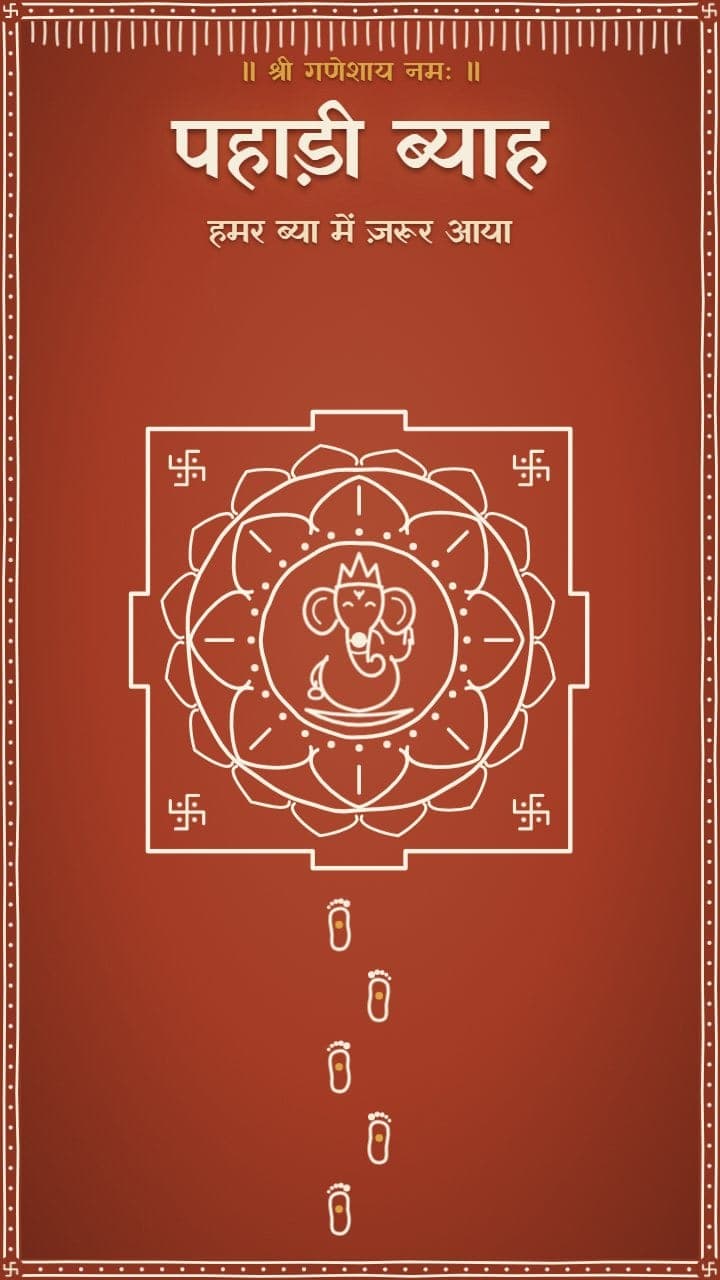
Scene 1
॥ श्री गणेशाय नमः ॥
Ganesh, painted in aipan
- What guests see
- A floor freshly coated in geru and a single dot of rice paste. Then a finger paints: the frame of the wall, a yantra of rings and lotus petals, Ganesh at its heart, and Lakshmi's footprints walking in from the doorway.
- The Kumaon in it
- Aipan is Kumaon's ritual floor and wall art: red ochre (geru) painted over with biswar, a paste of soaked, ground rice, by hand. Lakshmi's footprints are drawn walking into a home to bring prosperity in. Aipan has carried a Geographical Indication tag since 2021.
- On the card
- Your invocation, the title पहाड़ी ब्याह and a welcome line in Kumaoni, written the way your family says it.
Optional tap: “Paint the aipan”

Scene 2
पहाड़
The valley at morning
- What guests see
- Morning on the snow range. Below it a green Kumaon valley: terraced fields stepping down the hill, a deodar forest, a stone temple with a wooden canopy roof on the ridge, the river, slate-roofed houses with geru walls, buransh trees in red bloom and yellow phyoli in the grass.
- The Kumaon in it
- The temple is drawn after the stone shikhars of Jageshwar; the buransh (rhododendron) is Uttarakhand's state tree; the houses wear the same geru and aipan as the floor in scene one.
- On the card
- Your invitation line, and both sets of parents as the hosts.
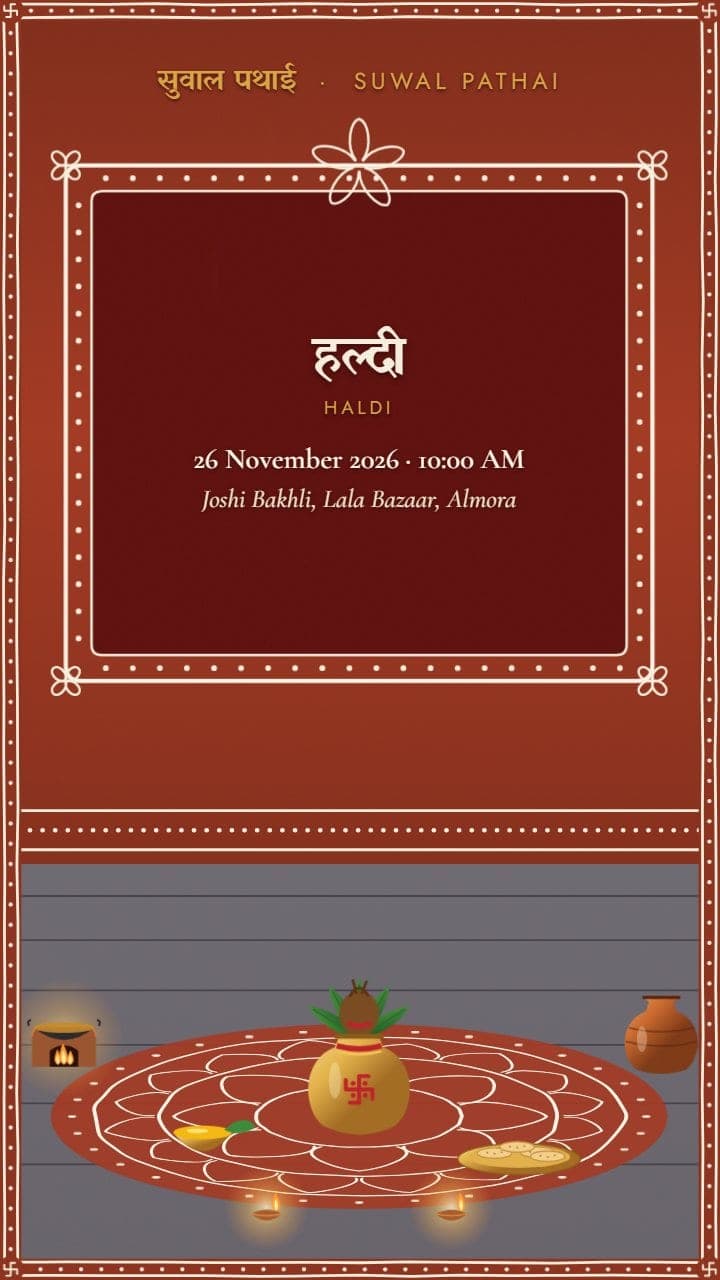
Scene 3
सुवाल पथाई
Suwal pathai and the haldi
- What guests see
- The courtyard of the house. An aipan chowki is painted on the slate floor, and on it the brass kalash with mango leaves and a coconut, haldi in a brass katori, a parat filling with suwal one by one, a copper gagri, the chulha and two diyas. The haldi card is painted onto the wall as a chowki of its own.
- The Kumaon in it
- Suwal pathai is the pre-wedding day when the women of the house roll thin wheat suwal, dry them in the sun and fry them, to be offered to the gods and shared with guests. It is held one, three or five days before the wedding, at both homes.
- On the card
- Haldi date, time and venue.
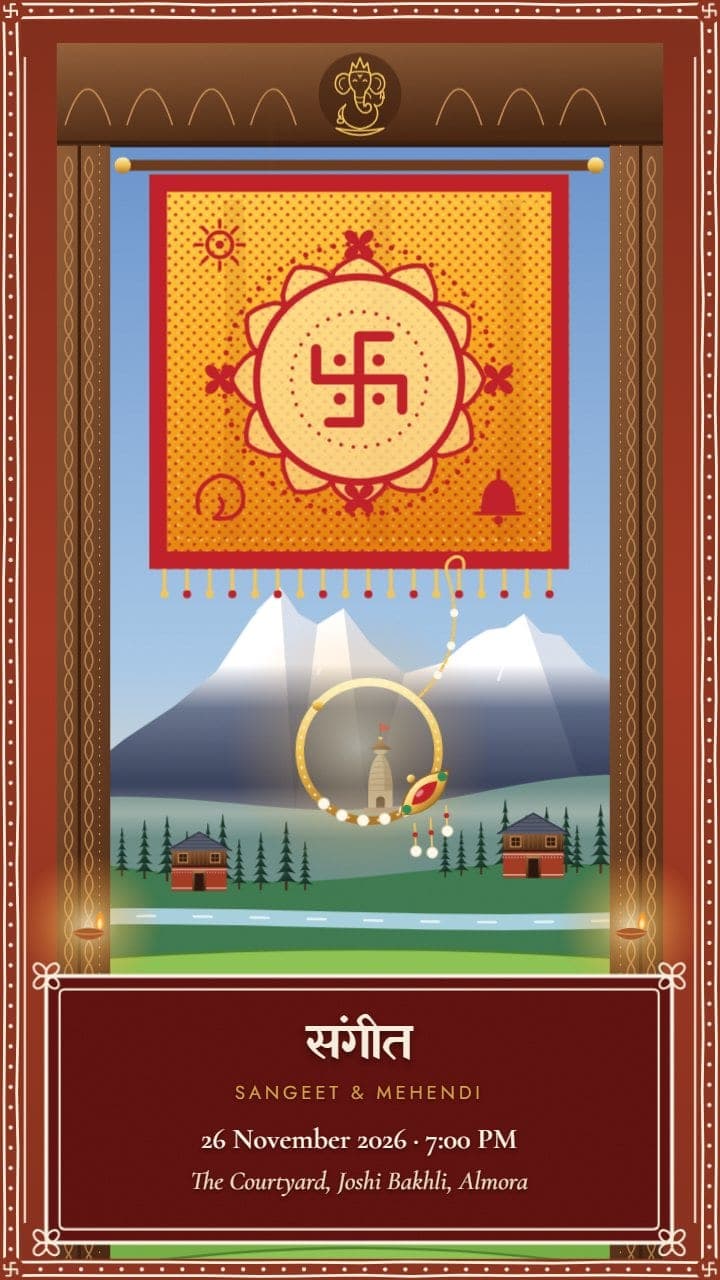
Scene 4
पिछौड़ा
The pichhora and the nath
- What guests see
- A carved likhai doorway with Ganesh on its lintel, open onto the hills. The pichhora is let down from its rod: saffron, red bandhani dots, a red border, and the aipan medallion at its heart, a swastik in lotus petals with the sun, moon, conch and bell in the corners. Then the great gold nath appears, hanging from its fringe.
- The Kumaon in it
- The rangwali pichhora is the saffron stole with red designs that Kumaoni brides and married women wear at every auspicious ceremony. Likhai is Kumaon's carved wood: door frames with Ganesh at the centre of the lintel.
- On the card
- Sangeet and mehendi date, time and venue.
Optional tap: “Unroll the pichhora”
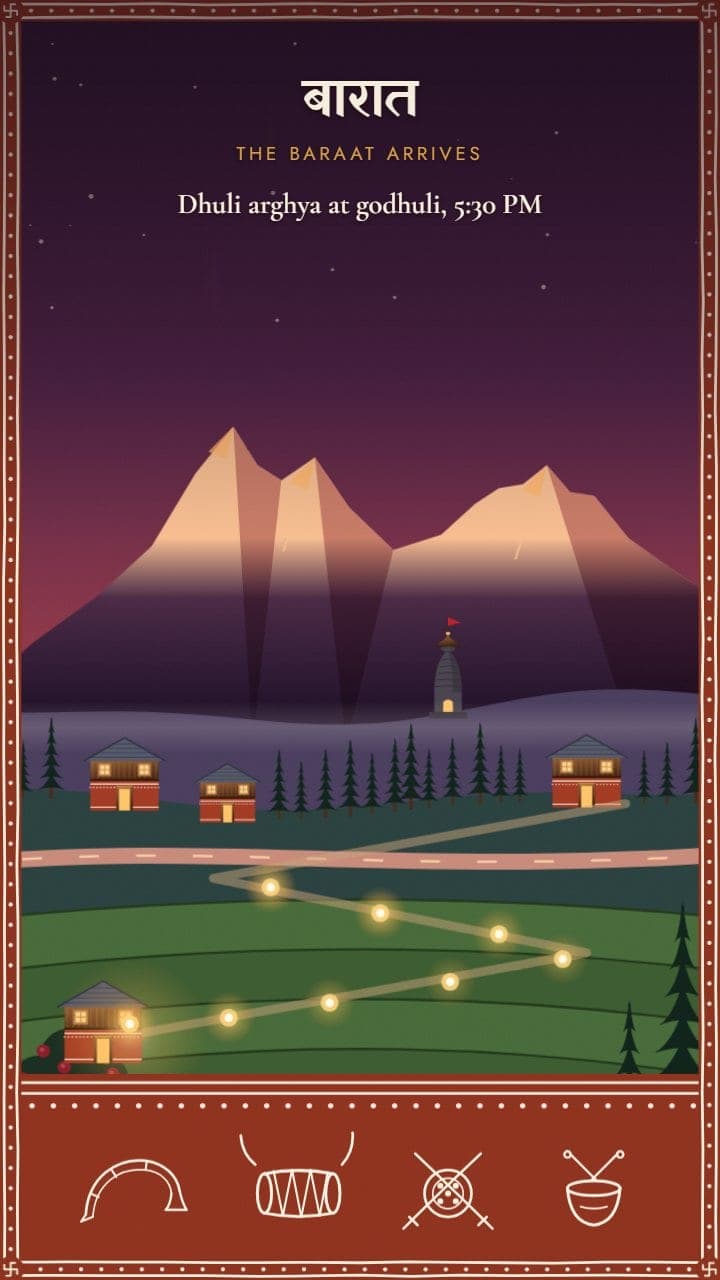
Scene 5
बारात
The baraat at dusk
- What guests see
- Dusk on the same valley. Lanterns gather at the upper village, then wind down the hill one after another to the bride's house, where the door is open and the light is on. Beneath, a frieze painted in aipan: the ransingha, the dhol, a chholiya dancer's crossed swords and shield, and the damau.
- The Kumaon in it
- In a Kumaoni wedding the baraat arrives at godhuli, the dusk hour, led by chholiya sword dancers and the dhol-damau. At the door the bride's father performs the dhuli arghya: he welcomes the groom as Vishnu and washes his feet.
- On the card
- The baraat line, with the dhuli arghya time if you add one.
Optional tap: “Light the baraat's way”
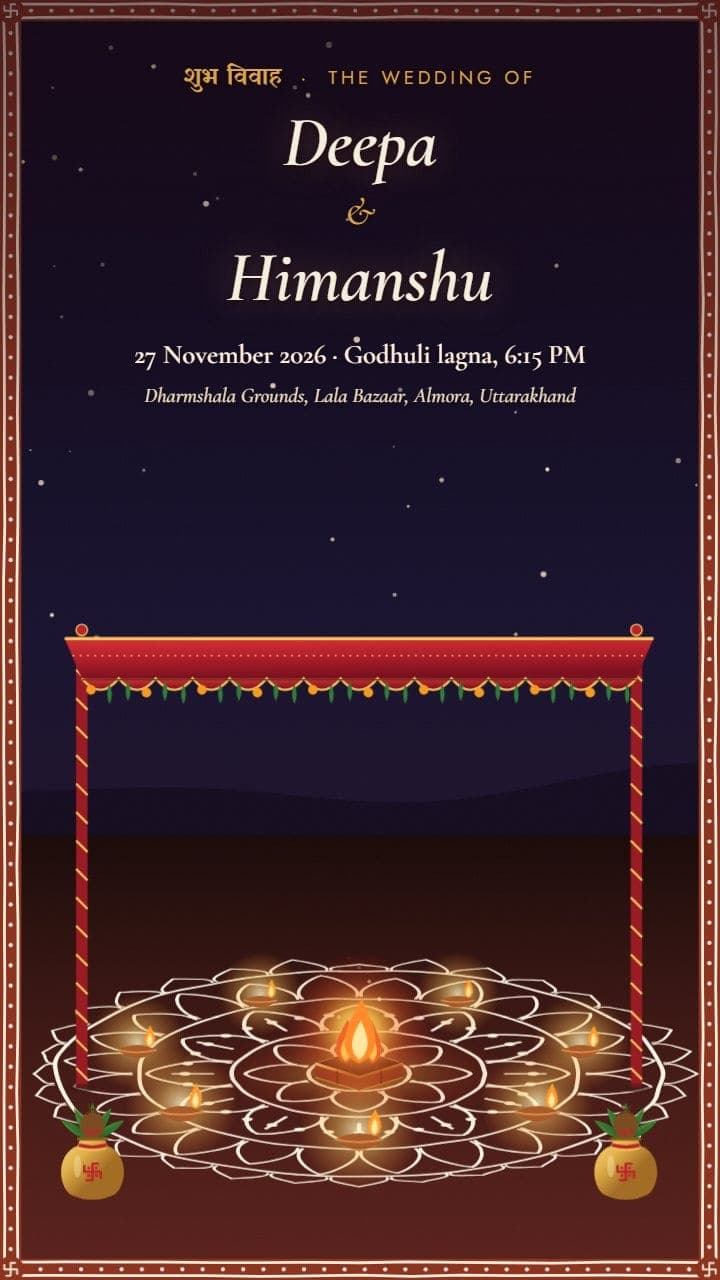
Scene 6
शुभ विवाह
Seven diyas for the pheras
- What guests see
- Night under a red mandap with a mango-leaf toran. A great aipan lotus is painted on the ground round the havan kund, the fire catches, and a light goes once round it, lighting seven diyas in turn. The couple's names are painted in by hand.
- The Kumaon in it
- On the card, the seven diyas stand for the seven pheras round the sacred fire, and a brass kalash with mango leaves keeps each front corner of the mandap.
- On the card
- Both names, the wedding date, the time or lagna, the venue, and up to two photos in aipan-bordered frames.
Optional tap: “Begin the pheras”
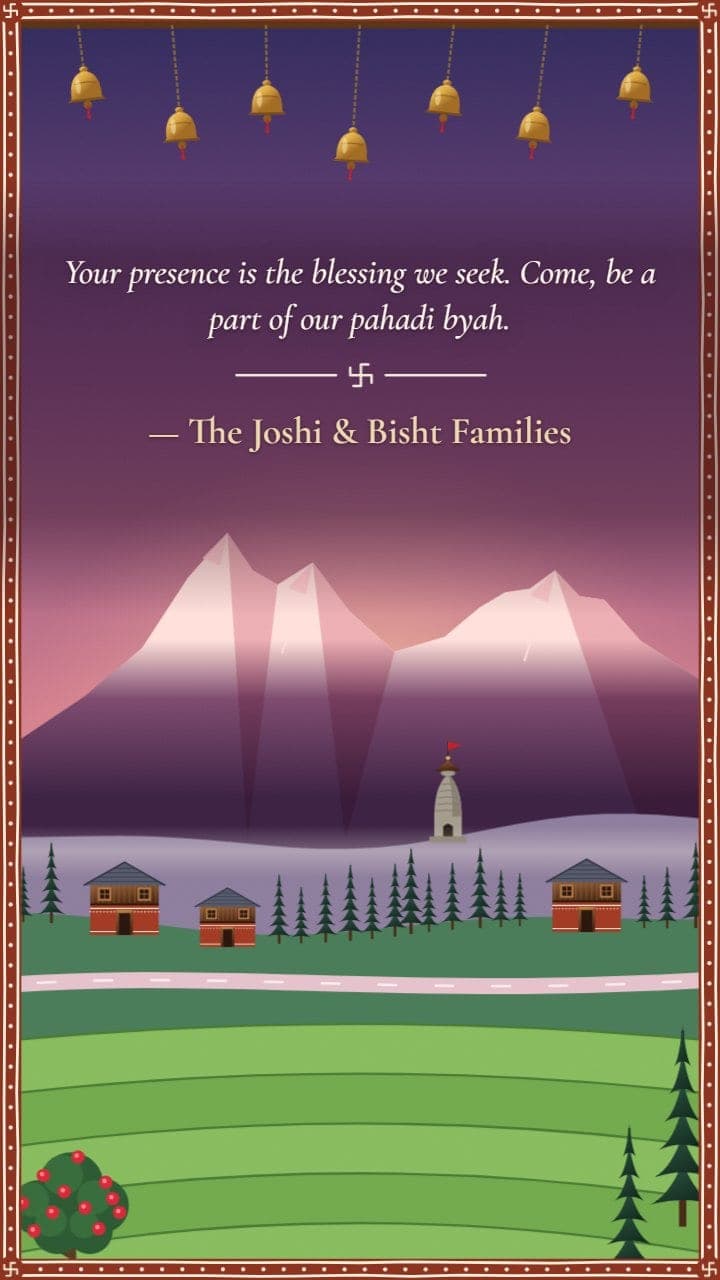
Scene 7
आशीर्वाद
Dawn, and the temple bells
- What guests see
- Dawn turns the snow pink above the green valley, and a row of brass temple bells swings along the top of the wall.
- The Kumaon in it
- Brass bells are how devotees thank Golu Devta in Kumaon; his temple at Chitai near Almora is hung with thousands of them.
- On the card
- Your closing message, and your families' names, which sign the card last.